

SB 79 - The Transit Housing Law That’s Changing the Game for California Developers
SB79 - What it is, who it’s for, and how Greenwood & Moore can help you use it.
If you’ve been following our blog series, you already know California has been busy rewriting the rules on housing development. From SB 9 to SB 1123, the state has handed property owners and developers a real toolkit for getting projects built faster and smarter. Senate Bill 79 is the latest, and in many ways the most ambitious, addition to that toolkit.
Signed into law by Governor Newsom on October 10, 2025, and taking effect July 1, 2026, SB 79 is California’s big bet on transit-oriented development (TOD). In plain English: if your property is near a major transit stop, the rules just changed significantly in your favor.
So, What Exactly Is SB 79?
SB 79 - the Abundant & Affordable Homes Near Transit Act - overrides local zoning restrictions to allow taller and denser residential development on sites located near qualified transit stops. We’re talking about areas near heavy rail, light rail, commuter rail, and bus rapid transit lines.
The law applies in “urban transit counties” - counties with more than 15 passenger rail stations. That means the Bay Area, Sacramento County, and Southern California’s urban counties are all in play.
The Bottom Line:
If your site is within a half mile of a qualifying transit stop, SB 79 likely unlocks development potential that local zoning was previously blocking.
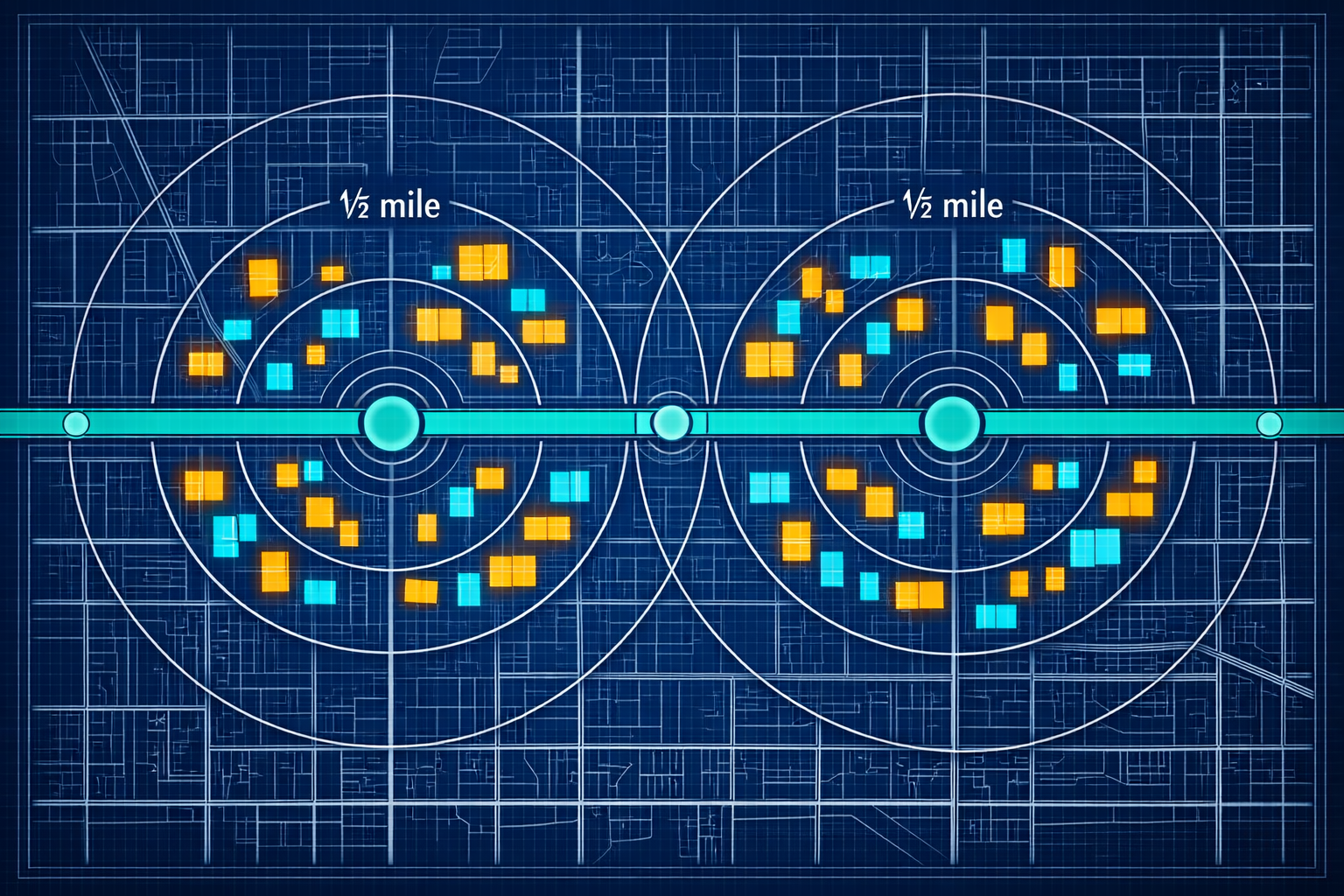
Two Tiers, Two Distance Bands - How it Works
SB 79 creates a tiered system based on two factors: (1) the quality of nearby transit and (2) how close your site is to the transit stop.
The Two Transit Tiers
| The Two Transit Tiers | |
|---|---|
| Tier 1 Stops | Heavy rail or very high-frequency commuter rail (72+ trains/day) - think BART, Caltrain, Metro B and D lines |
| Tier 2 Stops | Light rail, moderate-frequency commuter rail (48 - 71 trains/day), or Bus Rapid Transit (RT) |
Within each tier, the closer you are to the stop, the more density and height you can build.
Here’s a simplified view of what that means for Tier 1 stops:
| Tier 1 Stops | Development Standards Simplified View |
|---|---|
| Adjacent to Stop | Up to 9 stories; up to 120 du/acre; FAR up to 3.5 |
| Within ¼ Mile | Up to 7 stories (75 ft min); up to 120 du/acre; FAR up to 3.5 |
| Within ½ Mile | Up to 6 stories; up to 80–100 du/acre depending on tier |
| Tier 2 Stops - Development Standards Simplified View |
|---|
| For Tier 2 stops, the numbers are somewhat lower but still represent a significant step up from typical local zoning. Many sites that were previously capped at 3–4 stories and 30–40 units per acre can now potentially go much higher. |
Is This Just Another Housing Bill?
Fair question. And yes, SB 79 is very much part of a broader legislative wave. But here’s what makes it different from the others we’ve covered:
- SB 9 targeted single-family lots and small infill - up to 4 units, limited scale.
- SB 1123 opened up small subdivisions on vacant infill lots - up to 10 homes on 1.5 acres.
- SB 79 is aimed squarely at mid-rise multifamily development near transit stops - a fundamentally different scale and audience.
This bill is not designed for the homeowner adding a backyard unit. SB 79 is a tool for developers, investors, and property owners sitting on larger sites within transit corridors who want to build more housing - and build it faster -- than local zoning has historically allowed.
It can also be paired with other laws you’ve heard us talk about - SB 35 for streamlined ministerial approval of affordable projects, the State Density Bonus Law for additional units, and SB 330 for project protections. The combination can be powerful.
Who Should Be Paying Attention?
Developers & Investors
If you own or are acquiring a site within half a mile of a qualifying transit stop, SB 79 may let you build significantly more units than local zoning currently allows. That changes the pro forma. It changes the land value. And it changes what’s worth pursuing. Early feasibility analysis is essential — the opportunity window is opening now!
Commercial Property Owners
SB 79 applies to sites zoned residential, mixed-use, or commercial near transit. That means underperforming strip malls, surface parking lots, or older commercial buildings near a rail or BART stop could be repositioned for residential or mixed-use development at a scale that wasn’t possible before.
Architects & Project Teams
SB 79 opens design possibilities that were off-limits under local zoning. But navigating the two-tier system, distance requirements, affordability minimums, and the interplay with other streamlining laws requires early, precise civil engineering and land use analysis — before design gets too far down the road.
Homeowners Near Transit Corridors
SB 79 is not a homeowner-addition tool — projects must have at least 5 units. But if you own a larger lot near transit and have been curious about its development potential, now is a good time to ask the question. You may be sitting on more opportunities than you realize.
A Few Things to Keep in Mind
SB 79 is powerful, but it’s not plug-and-play. There are important qualifications and guardrails:
- Minimum 5 dwelling units required — this is not a tool for small infill additions.
- Projects cannot require demolition of existing rent-controlled housing that was occupied in the past 7 years.
- Affordability requirements apply — the specific thresholds tie into the Density Bonus Law and SB 35 eligibility.
- Labor standards kick in for projects over 85 feet, including skilled and trained workforce requirements.
- *Local governments have some flexibility to adopt their own TOD Alternative Plans by July 1, 2026, which may shift how the law applies in a given city.
*The last point regarding local government matters a lot for Bay Area clients. Cities are actively working through their SB 79 implementation right now. Knowing what applies - and when - in your specific district is critical before making any project decisions.
How Greenwood & Moore Can Help You
SB 79 is a sophisticated tool designed for sophisticated projects. At G&M, we’re here for clients who may want to consider and test SB 79, prepare the early-stage work - the feasibility, the site analysis, the entitlement groundwork - is exactly where our 30+ years of California land use and civil engineering experience makes a real difference.
Here’s when to call us:
- You own or are evaluating a site near a transit corridor and want to know if SB 79 applies.
- You need to confirm which tier your nearest transit stop falls under and what development standards that unlocks.
- You’re working with an architect and need early civil and land use analysis before design progresses.
- You want to understand how SB 79 stacks with other laws like SB 35, the Density Bonus Law, or SB 1123.
- You want to understand what your local district is doing with its TOD Alternative Plan before the effective date of July 1, 2026.
We can help you ask the right questions before you invest in design, and we can help you move efficiently through the entitlement process once you decide to go.
Ready to Find Out If Your Site Qualifies?
Greenwood & Moore has been helping California property owners, developers, and architects navigate the state’s housing laws for more than 30 years. SB 79 is new territory — and we’re already working through it with clients.
If you have a site near a transit stop and want to understand your options, let’s talk.
greenwoodmoore.com • (510) 581-2772
Since 1994, G&M’s goal is to “Make our Clients' Vision a Reality."